
The Armenian Philosophical Academy (APHA) is a scholarly public organization that serves as the ideological bearer and worthy continuer of Armenian philosophical values. It was established in Armenia on the basis of the Sevan School of Philosophy, founded in 1987.
On July 16, 1993, at the founding assembly held at the National Academy of Sciences of the Republic of Armenia, the Armenian Philosophical Academy was officially recognized as the legal successor of the Sevan School of Philosophy; its charter was adopted, the founding members were elected, and the Presidium was formed under the presidency of Academician Georg Brutian.
The Academy aims to unite the collective potential of Armenian philosophical thought, to promote the development of Armenian philosophy and its integration into world philosophy through various means, to support cooperation among prominent scholars and educational institutions in the field of philosophy, to foster the growth of young scholars in the social sciences, and to establish research groups and other internal academic scientific structural units.
On December 27, 2007, the Armenian Philosophical Academy celebrated its 20th anniversary.
On this occasion, the Academy received numerous congratulatory messages from its international members and distinguished scholars from the United States, the United Kingdom, Lebanon, France, Poland, Greece, Bulgaria, Austria, and other countries.
Below are selected congratulatory messages addressed to the Armenian Philosophical Academy and its Founder-President, Academician Georg Brutian.
The Armenian Philosophical Academy expresses its deep gratitude to all its international members and colleagues for their warm congratulations and continued support.
On December 27, 2007, the Armenian Philosophical Academy celebrated its 20th anniversary.
Peter Kemp
President of the International Federation of Philosophical Societies
President of the 20th World Congress of Philosophy (Denmark)
“As President of the International Federation of Philosophical Societies—a federation whose primary aim is to promote the development of professional relations and the exchange of ideas among philosophers of all countries—I would like to congratulate the Armenian Philosophical Academy on the occasion of its 20th anniversary. Your Academy is one of the most important philosophical societies not only in Europe, but also worldwide. It is highly active and, since its foundation, has exerted a continuous philosophical and cultural influence and has established a significant presence in the field of contemporary philosophy. I would like to offer my special congratulations to the founding President of the Academy, Professor Georg Brutian, for his outstanding work in establishing, developing, and bringing the Academy to its present level.”
United States
Noam Chomsky
Chair of the Department of Philosophy and Linguistics at Massachusetts Institute of Technology
“I wish to congratulate you on all that the Academy has already achieved and to wish it a bright and fruitful future.”
Haig Khatchadourian
Professor, University of Wisconsin–Milwaukee
“Warm congratulations on the occasion of the 20th anniversary of the Armenian Philosophical Academy. I wish the Academy and all its members continued success.”
John McDowell
Professor, University of Pittsburgh
“I congratulate the Armenian Philosophical Academy on the occasion of the 20th anniversary of its founding.”
Greece
Evangelos Moutsopoulos
Co-President, International Academy of Philosophy
Honorary Rector, University of Athens
“On behalf of the Greek Section of the International Academy of Philosophy, we warmly congratulate you and wish further success in your distinguished international activity.”
Georgia Apostolopoulou
Professor, University of Ioannina
“I congratulate the Armenian Philosophical Academy on its 20th anniversary and wish continued fruitful activity contributing to philosophy and culture.”
Myrto Dragona-Monachou
Professor, University of Athens
“Please accept my warm congratulations and best wishes for health, happiness, and longevity.”
Europe
Michael E. Stone
Honorary Lifetime President, International Association for Armenian Studies (Israel)
“The founding, development, and activities of the Academy, as well as the publication of Armenian Mind, are major achievements in international philosophical life.”
Zdzisław Cackowski
Former Rector, Maria Curie-Skłodowska University (Poland)
“The Armenian Philosophical Academy has already reached great heights, and I wish it even greater success.”
Ukraine
Myroslav Popovych
Academician, National Academy of Sciences of Ukraine
“The energy and intellectual activity of Academician Georg Brutian play a significant role in contemporary philosophical life and international scholarly cooperation.”
A significant contribution to the establishment of the Armenian Academy of Philosophy (AAP) was made by Academician Viktor Hambardzumyan, President of the Academy of Sciences of the Armenian SSR, and Academician Georg Brutian, Founding President of the Armenian Academy of Philosophy. It is difficult to say whether such an academy would have been created without their consistent and purposeful efforts.
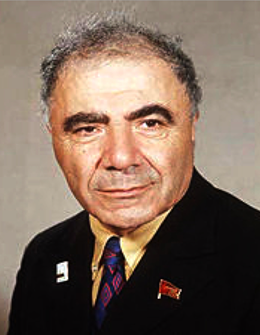
President of the Academy of Sciences of the Armenian SSR Viktor Hambardzumyan
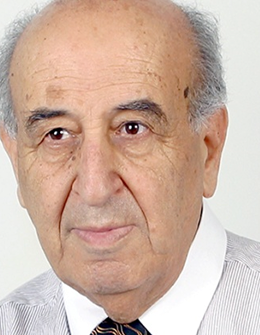
Founding President of the Armenian Academy of Philosophy Georg Brutian
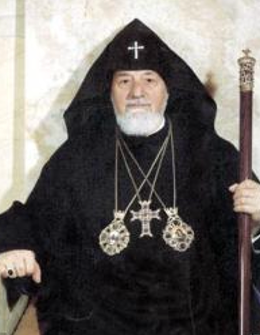
Catholicos of All Armenians
Vazgen I
At that time, almost all republics of the Soviet Union had one academy of sciences. The exceptions were two republics—the Russian Federative Republic and Ukraine. The Academy of Sciences of the Soviet Union functioned as a whole, which, in essence, considered Russia as its own academy. At the same time, several branch academies operated in Russia, such as the Academies of Agriculture, Medical Sciences, Construction and Architecture, and others. In the other republics of the Soviet Union, apart from Ukraine, there were no branch academies.
Under these circumstances, an attempt was made in Armenia to establish a branch academy, which would ultimately become the country's second academy. The founding of a philosophical academy was particularly challenging, as issues related to philosophy and the social sciences in general were strictly controlled and resolved by the Central Committee of the Communist Party of the Soviet Union.
Nevertheless, Academician Viktor Hambardzumyan clearly understood how to act under such conditions—how to bypass administrative and ideological obstacles and achieve a goal that would serve his people and national science.
By a joint decision of December 24, 1987, of the Armenian Branch of the Philosophical Society of the USSR, the Central Committee of the Leninist Komsomol of Armenia, and the Executive Committee of the Sevan City Council, the “Center for Philosophical Thought” was established in the city of Sevan.
This non-governmental institution aimed to promote the scientific and socio-political activity of young people through joint research work by distinguished philosophers and young people interested in philosophy.
The Center had the following structure:
The founding President of the Chair of Philosophy was Academician Georg Brutian, Academic Secretary of the Department of Philosophy and Philology of the Academy of Sciences of Armenia, and President of the Armenian Branch of the Philosophical Society of the USSR.
The Honorary Advisor of the Chair was Academician Viktor Hambardzumyan, President of the Academy of Sciences of Soviet Armenia.
The Chair defined the main directions of philosophical research carried out at the Center, supervised the joint work of trustees, scientific advisors, and lyceum students, approved the composition of the Board of Trustees and the Chief Trustee, selected students and auditors of the Lyceum, and discussed and guaranteed the publication of philosophical research conducted at the Center.
In 1994, during the reaffirmation of the Charter of the Chair of Philosophy, it was officially designated as the Armenian Academy of Philosophy. The Charter established that the Armenian Academy of Philosophy is the legal successor of the Chair of Philosophy.
This event received wide coverage in the press. Newspapers (“Yerevan University,” September 15, 1993; “Yerkir,” August 24, 1993; “Hayastani Hanrapetutyun,” August 21, 1993; “Golos Armenii,” August 26, 1993) noted that “based on the Sevan Chair of Philosophy, a philosophical academy operates in Yerevan,” whose mission is to unite the collective potential of Armenian philosophical thought, promote its further development, and advance science.
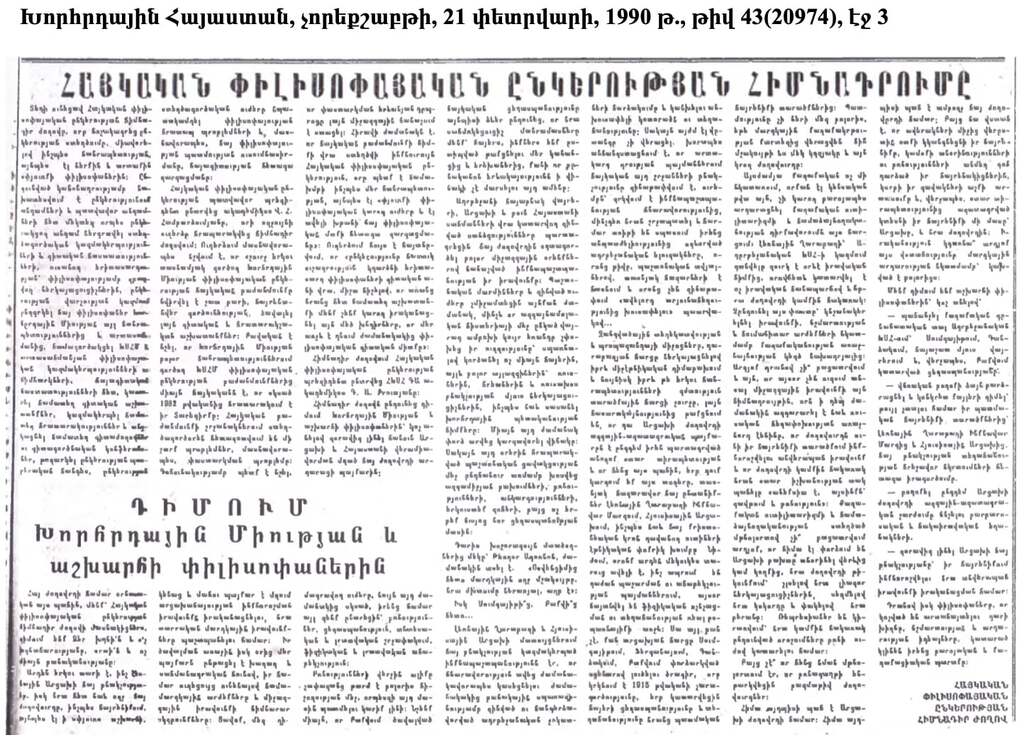
Soviet Armenia, Wednesday,
February 21, 1990, No. 43 (20974), p. 3:
It should be noted that in 1987, when the Armenian Academy of Philosophy was founded, only two philosophical academies existed in the world:
Thus, the Armenian Academy of Philosophy became the third philosophical academy in the world. At the same time, it should be emphasized that the concept of “academy” is not uniformly applied across countries. It is not accidental that in an international reference work devoted to philosophy and philosophers, the first two academies are classified among universities, whereas the Armenian Academy of Philosophy is included among research institutions.
Consequently, the oldest continuously functioning philosophical academy in the world today operates in Armenia—the Armenian Academy of Philosophy.
On the occasion of the founding of the Chair of Philosophy, Academician Viktor Hambardzumyan delivered a message, the text of which follows:
“Dear friends,
The ancient Armenian land has founded many temples, and also many academies, both man-made and spiritual. Today, we are present at the solemn opening of a new academy, and I see deep meaning in this.
First of all, this is an academy of philosophy. Philosophy expresses the essence of an era. It is the calling card through which a people presents itself to the world. The Armenian people are philosophical. Paraphrasing the great Armenian poet Hovhannes Tumanyan, one may say that every Armenian is a philosopher, and an Armenian philosopher is a philosopher twice over, and I would add that the chosen among Armenian philosophers are philosophers three times great. It is no coincidence that one of the greatest Armenian thinkers was called David the Invincible, the philosopher.
May the Armenian Chair of Philosophy, founded in Sevan, be worthy of David the Invincible and further elevate the glory of Armenian philosophical thought.
I am especially pleased that the main purpose of the Chair founded in Sevan is to support the philosophical advancement of young people, boys and girls alike. Alongside the Chair, a Philosophical Lyceum and a Philosopher’s Library have been established. In this triad, I see the fundamental prerequisites for the creative growth of philosophical thought.
Finally, I consider the creation of new centers of creative thought a reliable guarantee of the continuous and progressive development of our people’s spiritual culture. Although the Armenian people have passed through many disasters in their centuries-long history, they have preserved their spiritual and national identity and created values that testify to their undeniable creative potential.
I hope that the Chair of Philosophy and the Philosophical Lyceum founded in Sevan will give new impetus to the progress of the Armenian creative spirit and philosophical thought.
I wish you success in this nationally beneficial and patriotic endeavor.”
Academician Viktor Hambardzumyan
President of the Academy of Sciences of the Armenian SSR
Throughout its history, the Academy has attached great importance to the development of young philosophers. For this purpose, on the basis of the Philosophical Lyceum, an association of young philosophers was established, which regularly organized seminars for youth. Whenever possible, young scholars were included in delegations traveling abroad, thus supporting their academic advancement. The early successes of the Lyceum’s work are evidenced by the establishment of a “Young Philosopher’s Chair” in the Yearbook of the Armenian Branch of the Philosophical Society of the USSR, where, with the endorsement of the Chair, scholarly articles by Lyceum students were published.
The Academy discussed and published, under its own imprint, research works by both Academy members and other scholars recommended by them. Special importance was also attached to the growth of young researchers in the publishing field.
Going beyond the framework of Armenian reality, the Armenian Academy of Philosophy has not only pursued the development of Armenian philosophical thought but has also contributed to the creation of global philosophical crossroads. It has brought together not only Armenian philosophers but also major thinkers from abroad, who have repeatedly supported their Armenian colleagues in professional matters.
According to the Charter of the Armenian Academy of Philosophy (until 2023), citizens of the Republic of Armenia and foreign countries holding a doctoral degree, who have enriched science with works of significant importance, accept the Academy’s Charter, and support the realization of its goals, could be elected as members. At various times, the Academy’s membership has included Viktor Hambardzumyan, Catholicos Vazgen I, and world-renowned philosophers such as Hans-Georg Gadamer (Germany), Donald Davidson (USA), Frederick Copleston (UK), Carl Hempel (USA), Jaakko Hintikka (USA), Georg Henrik von Wright (Finland), and others.
World-renowned leading philosophers from abroad have been elected as members of the Armenian Academy of Philosophy, whose names alone constitute a great honor and source of prestige for the Academy. At the same time, the Academy’s foreign members, being familiar with its activities, have warmly welcomed their membership in the Armenian Academy of Philosophy.
The APhA has organized several international conferences and theoretical seminars (“round tables”) both in Armenia and in various foreign countries, including a Round Table on issues of argumentation within the framework of the 18th World Philosophical Congress in Brighton (United Kingdom); a Finnish-Armenian conference in Turku (Finland, 1988), in which nine philosophers from Armenia participated; a conference for young scholars devoted to issues of argumentation in Sevan (Armenia, 1988); an Armenian-Finnish-Dutch conference on argumentation in Yerevan and Sevan (Armenia, 1989); and others.
One of the records of the Academy of Sciences of the Armenian SSR states that the Presidium decided to hold a conference “jointly with the Ministry of Public Education of the Armenian SSR and Yerevan State University, involving the Sevan Chair of Philosophy in the organizational and scholarly work.” Incidentally, in order to ensure the high theoretical level of that conference, the Armenian Academy of Philosophy carried out extensive preparatory work, including the organization of a debate on the topic “The Definition of Argumentation, Its Constituent Elements, and Their Interrelations” in February 1989, which continued until April. Subsequently, the debate went beyond the scope of the stated topic and also addressed a number of other related fundamental issues.
The Armenian Philosophical Academy also took an active part in international conferences organized by other institutions. These included the international conference “Argumentation, Logic, and Knowledge” held in Ghent (Belgium, 1989), in which four speakers from Armenia participated; the Second International Conference on Argumentation held in Amsterdam (the Netherlands, 1990); the international conference “The Application of Argumentation Theory in Politics, Industry, and Business” held in Saint Petersburg (Russian Federation, 1992); and the international conference “Argumentation Theory and Practice” held in Turku (Finland, 1993).
Joint efforts between the Armenian Philosophical Academy and other institutions in organizing academic conferences have also been substantial. A particularly important role was played by the scholarly session titled “Problems of Interpretation and Evaluation of 20th-Century Armenian Culture,” held at the National Academy of Sciences, which was initiated by the Humanities Division of the National Academy of Sciences and the Armenian Philosophical Academy.
The Armenian Philosophical Academy has also been highly active in the field of publishing. Under the imprint of the APA, research works have been published both by members of the Academy and, under their sponsorship, by other scholars as well.
In 1983, under the joint imprint of the Academy of Sciences of the Armenian SSR and the Armenian Section of the Philosophical Society of the USSR, a booklet by Viktor Hambardzumyan, President of the Academy of Sciences of the Armenian SSR, entitled “Inverse Problems in the Natural Sciences,” was published. This once again attests to Viktor Hambardzumyan’s close ties with the philosophical community.
In the field of publishing, great importance was also given to the development of young scholars. This is evidenced by the establishment in 1993 of the “Young Scholar’s Lectern” series, in which the works of young researchers were published.
From the day of its founding, the Armenian Philosophical Academy has been supported by a number of organizations. First and foremost, it should be noted that the Academy of Sciences of Armenia, as a patron of the Armenian Philosophical Academy, has carried out highly beneficial activities for the Academy. The attention of Viktor Hambardzumyan, President of the Academy of Sciences, toward the Armenian Philosophical Academy was so great that he read and even made corrections to the Academy’s Charter, and on October 5, 1988, at his initiative, the Presidium of the Academy of Sciences adopted the following resolution:
“153. On the patronage of the Sevan Philosophical Society and the allocation of a research staff position to the Sevan Philosophical Center
a) The Academy of Sciences of the Armenian SSR shall be considered the patron (sponsor) of the Sevan Philosophical Society.
b) For the purpose of promoting philosophical research in the Republic and carrying out joint scholarly work by leading philosophers and by boys and girls, as well as young people interested in philosophy, one research staff position shall be allocated to the Sevan Philosophical Center. An additional annual amount of 3,600 rubles shall be allocated to the Institute of Philosophy and Law of the Academy of Sciences of the Armenian SSR to cover the salary of the research staff member of the Sevan Philosophical Center.”
President of the Academy of Sciences of the Armenian SSR,
Academician V. Hambardzumyan
Academic Secretary of the Academy of Sciences of the Armenian SSR,
Academician D. S. Sedrakyan
On September 1, 1993, at the initiative of Academician Fadei Sargsyan, President of the National Academy of Sciences of the Republic of Armenia, and Academician Georg Brutian, President of the Armenian Philosophical Academy, a decision was adopted “On Cooperation and Mutual Assistance between the National Academy of Sciences of the Republic of Armenia and the Armenian Philosophical Academy.” The Presidium of the National Academy of Sciences of the Republic of Armenia resolved:
“To approve the Agreement on Cooperation and Mutual Assistance between the National Academy of Sciences of the Republic of Armenia and the Armenian Philosophical Academy.”
Under this agreement, the Armenian Philosophical Academy was provided with comprehensive support and was regarded as “the expert of the National Academy of Sciences in the field of philosophy.”
By a decision of the Presidium of the National Academy of Sciences of the Republic of Armenia at its session of June 31, 1995, accepting the Agreement of September 1, 1994 between the National Academy of Sciences of the Republic of Armenia and the Armenian Philosophical Academy on cooperation and mutual assistance, the Presidium authorized the Armenian Philosophical Academy and the International Institute for Argumentation to publish their works under the imprint of the “Science” Publishing House of the National Academy of Sciences of the Republic of Armenia.
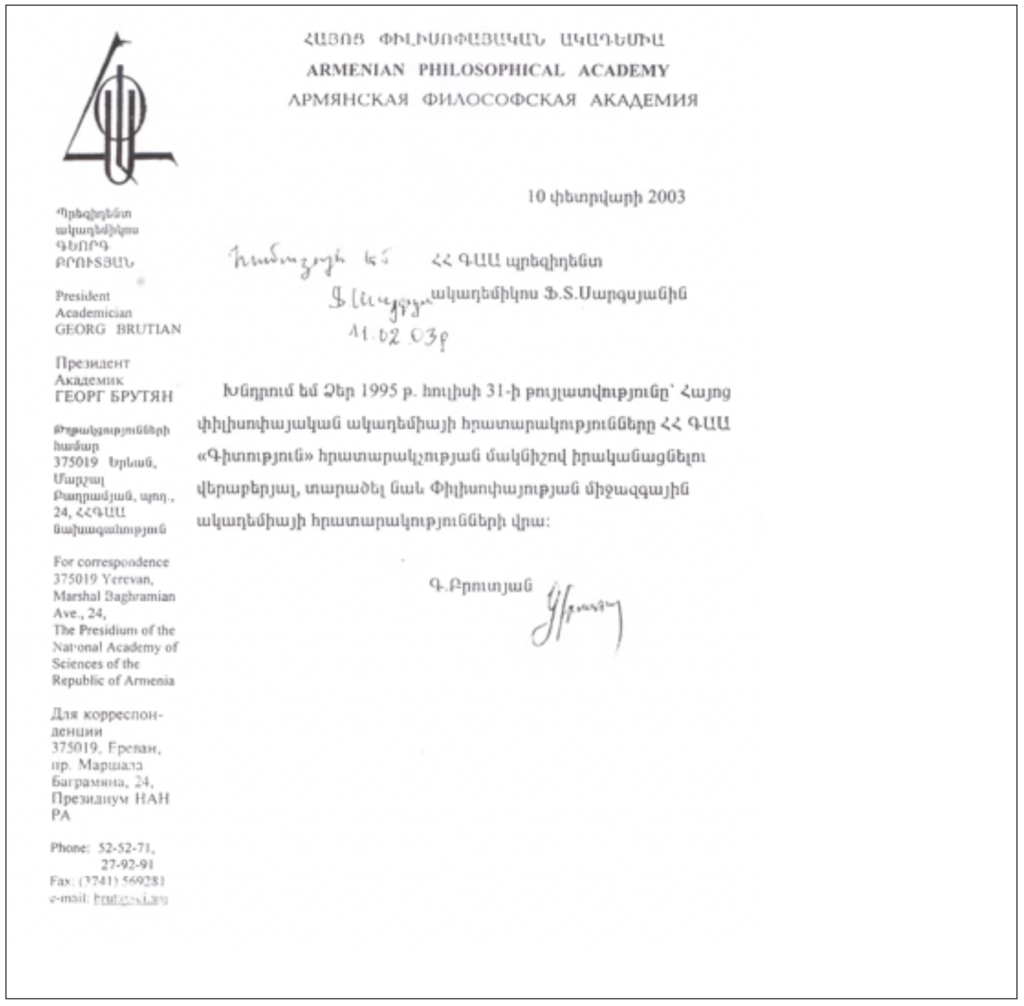
Among the patrons of the Armenian Philosophical Academy, Yerevan State University played an important role. By a decision of the Rectorate of Yerevan State University dated December 29, 1988, represented by Rector, Academician Sergei Hambardzumyan, Yerevan State University was recognized as the patron of the Philosophical Society.
It is also highly significant that earlier that same year, on September 8, the University Council adopted a decision according to which, “to make the selection of personnel in the fields of philosophy and sociology at Yerevan State University more purposeful and to further improve the philosophical education of the students of the Sevan Philosophical Lyceum,
By a decision of the Presidium of the Philosophical Society of the Soviet Union, the Philosophical Society of the USSR was recognized as a patron of the Philosophical Society (Imastasirutyan Kachar) and appealed to the Presidium of the Academy of Sciences of the USSR, as well as to the Rectorate of Lomonosov Moscow State University, to also become patrons of the Philosophical Society. Another decision stated that, taking into account the importance of establishing the Philosophical Society, it was deemed necessary in 1989 and 1990 to exempt the Armenian Philosophical Society from transferring 50% of its profits to the Presidium of the Society, in order to use those funds for the purposes of the Philosophical Society.
Since 2012, a prominent patron of the Armenian Philosophical Academy has been Khachatur Abovian, Armenian State Pedagogical University (ASPU). With the support of ASPU and in cooperation with it, a number of international conferences have been organized. In 2012, during that period, ASPU Rector, Doctor of Pedagogical Sciences, Professor Ruben Mirzakhanyan, at the proposal of APA President Georg Brutian, was elected Honorary President of the Armenian Philosophical Academy. Several ASPU professors were awarded the Academy’s highest honors — the large and small “David the Invincible” medals (see the “Conferences” section for 2012).
In 2001, at the initiative of the foreign members of the Armenian Philosophical Academy, the International Academy of Philosophy (IAP) was founded and registered in Armenia as an international scientific public organization. Academician Georg Brutian also served as its founding president. The Armenian Philosophical Academy became part of the International Academy of Philosophy as its Armenian branch. At the same time, the Armenian Philosophical Academy, while being a branch of the International Academy of Philosophy, retains its independent status both de jure and de facto. One of the proofs of this is that the Armenian Philosophical Academy actively participates in the implementation of the International Academy of Philosophy’s programs, particularly in the organization of international conferences and publishing activities. On the other hand, the Armenian Philosophical Academy benefits from all the opportunities provided by the International Academy of Philosophy. From the very first days of its founding, the Armenian Philosophical Academy has used the publishing house of the International Academy of Philosophy. The Armenian Philosophical Academy not only plays a key role within the International Academy of Philosophy but also carries out exemplary philosophical activity within its framework.
The Armenian Philosophical Academy may award individuals who support its activities with medals and diplomas established by the Academy. The highest award of the Academy is the David the Invincible commemorative medal. The Academy may also confer the title of Honorary Doctor.
The Academy has established the Tigran Petrosyan Prize for the best research of the year in the field of logic.
On December 27, 2007, the Armenian Philosophical Academy celebrated its 20th anniversary. The Academy’s foreign members sent congratulatory messages and best wishes from the United States, the United Kingdom, Lebanon, France, Poland, Greece, Bulgaria, Austria, and other countries.
On December 9, 2015, the founding President of the Armenian Philosophical Academy, Academician of the National Academy of Sciences of the Republic of Armenia, Georg Brutian, passed away. In 2016, Professor Robert Zijyan, Doctor of Philosophical Sciences and full member of the Academy, was elected President of the Armenian Philosophical Academy. In 2023, Hasmik Hovhannisyan, Doctor of Philosophical Sciences and full member of the Academy, was elected President.
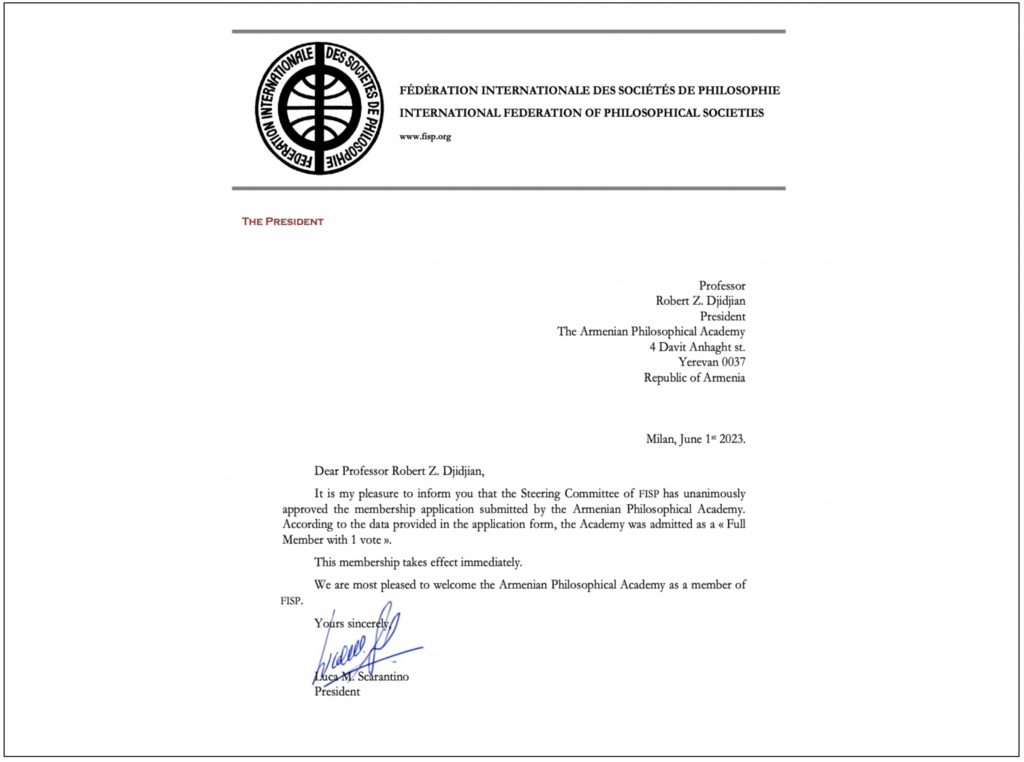
Since June 1, 2023, the Armenian Philosophical Academy has been a member of one of the world’s most prominent philosophical organizations — the International Federation of Philosophical Societies (FISP). The contribution of FISP Vice-President, Doctor of Philosophy, Professor Maria Baghramian, to this achievement has been significant, enabling Armenian — particularly Armenian-based — philosophers to be represented on the highest international philosophical platforms, including the 25th World Congress of Philosophy (see the “Conferences” section for details). In June 2026, the FISP Presidium will participate in two international conferences in Yerevan, Armenia (June 22–23 and June 26–27), and will also hold its two-day working sessions there.
The Armenian Philosophical Academy, as a scientific and scholarly organization, and its professional ties with FISP have a distinguished history. The Honorary President of FISP, Professor Evandro Agazzi, and the late Professor Peter Kemp — who served as President of FISP from 2003 to 2008 and as President of the 22nd World Congress of Philosophy in 2008 — are foreign members of the Armenian Philosophical Academy.
There are every reason to hope that the Armenian Philosophical Academy will strengthen and expand its patriotic mission and its role in the development of philosophical thought, for the benefit of friendship between the Armenian people and other peoples, and in the service of the advancement of both Armenian and world philosophy.

Armenian philosophical academy